
The Countries Asking Nepal to Prove It's Sustainable Are the Same Ones Flooding It
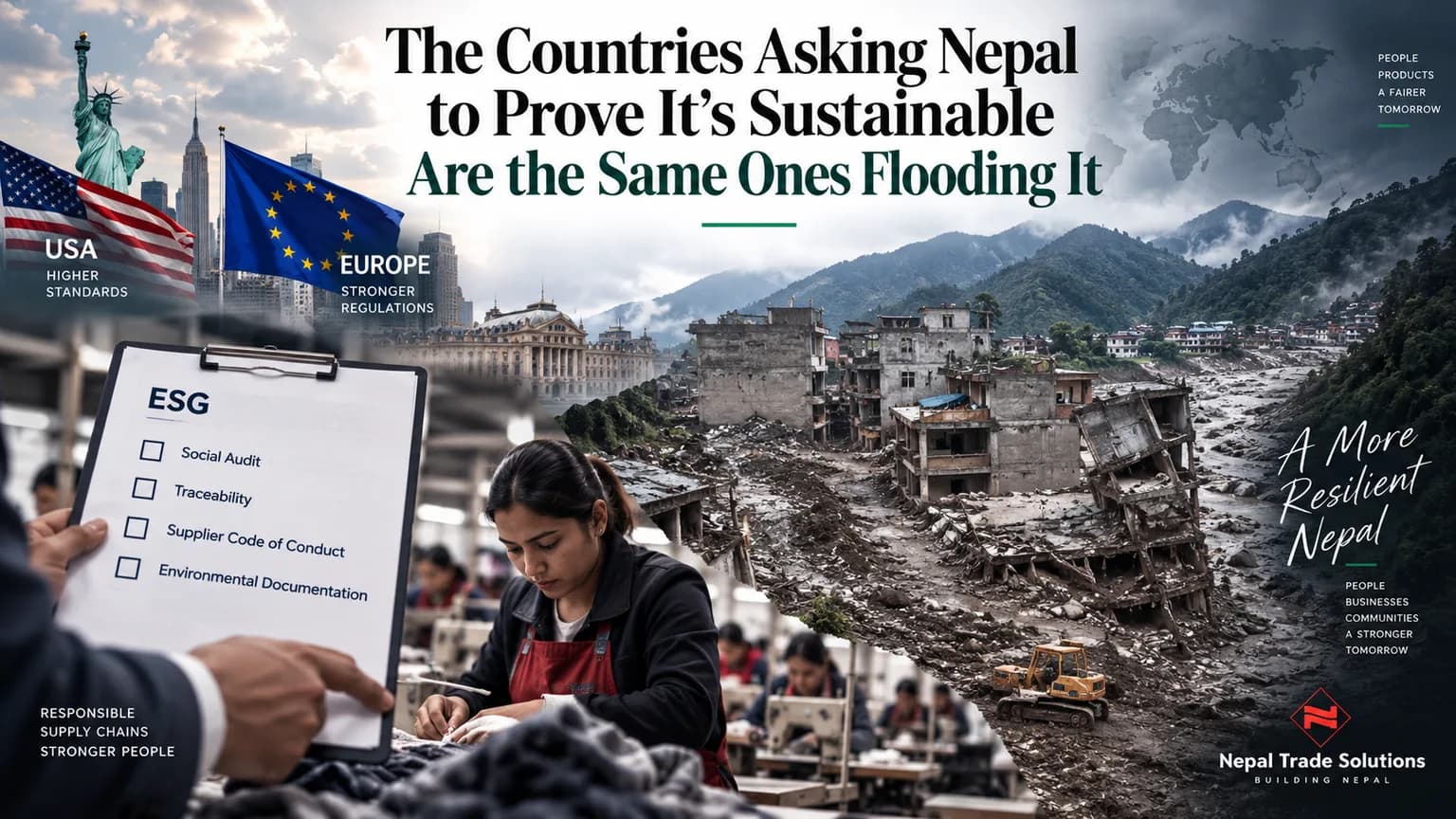
On August 26, 2024, a massive collapse of ice and rock high above the Bhote Koshi valley triggered one of the worst disasters Nepal has seen in decades.
Hundreds died. Then the number became more than a thousand. Thousands of people were reported missing or out of contact. Hydropower projects, roads, bridges, homes and businesses were destroyed.
And there is something almost surreal about what was happening elsewhere in Nepal at the same time.
In workshops and factories, businesses were filling out supplier questionnaires for international buyers. Social-audit forms. Traceability documents. Supplier codes of conduct. ESG checklists.
All of it designed to answer one question: Can this Nepali supplier prove that it is responsible enough for us to buy from?
That question is fair.
But there is another question that rarely gets asked: Who is helping that supplier become responsible — and who is paying for it?
That is the tension underneath much of the ESG conversation involving Nepal. And if you work anywhere between international buyers and Nepali manufacturers, you see it every day.
The rules changed after the game had already started.
Nepal's manufacturers are entering a global market where the expectations are already set. The world's major industrial economies had decades — in many cases, generations — to build factories, supply chains, infrastructure and capital before today's elaborate ESG systems became part of international trade.
Nepali manufacturers don't have that luxury. They are trying to industrialize now.
At the same time, they are being asked to meet standards developed for a much more mature industrial environment. That doesn't mean the standards are wrong. It means the starting points are different.
A manufacturer in Nepal may be operating with 20 or 30 workers. There may be no dedicated compliance manager. No sustainability department. No legal team. No ESG consultant sitting in the next office.
Raw materials may already cost substantially more than they do in much larger manufacturing economies. Financing is expensive. Logistics are difficult. Infrastructure remains limited. Cottage businesses compete directly with automated businesses.
And then the buyer says: "We also need your social audit, environmental documentation, traceability records and corrective-action plan."
The factory owner isn't necessarily refusing. Sometimes they're simply asking: "How do I do all of this?"
Nepal is not resisting sustainability.
This distinction matters. Nepal doesn't need an exemption from responsible business. Nepali workers deserve safe workplaces. Factories should treat people fairly. Child labour should not exist. Businesses should be transparent. Environmental damage should be reduced. Supply chains should be traceable. Manufacturers should continuously improve. I believe in all of that.
The problem is not the destination. The problem is the cost of getting there.
Nepal contributes roughly 0.1% of global greenhouse-gas emissions, yet the country is exceptionally vulnerable to climate change. The World Bank has estimated that, without adequate action, climate impacts could reduce Nepal's GDP by at least 7% by 2050.
Think about that for a moment. A country contributing a tiny share of global emissions can still lose a significant part of its economic output from the consequences of a warming planet.
And Nepal isn't experiencing climate change as an abstract discussion in an annual sustainability report. It is happening in the mountains. It is happening in the rivers. It is happening to roads, bridges, hydropower projects, farms and communities.
The Bhote Koshi corridor itself had already experienced another major glacial flood in July 2025. Fourteen months later, the same river system was hit again — this time by a dramatically larger disaster.
This is why we don't believe an audit alone solves the problem.
This is also something we have learned through our own work.
You can send an auditor into a factory. You can inspect the workers. You can check fire extinguishers. You can look at payroll records. You can review documentation. You can issue a report. And then you can leave. But what happens the next day? Nothing necessarily changes.
A factory owner can receive a 40-page supplier code of conduct and still have no idea what half of it means. They may not know why a buyer is asking for a particular certificate. They may not understand what a corrective-action plan should look like. They may have perfectly reasonable practices that they simply haven't documented properly. Or they may have genuine problems but no idea how to fix them.
That is why we increasingly see inspection as only one part of the job.
Before an audit, there is education. There is conversation. There is preparation. There is explaining what international buyers actually expect. There is helping a factory understand where it is already doing well and where it has gaps. There is helping management understand what needs to change before somebody arrives with a clipboard and a pass-or-fail mentality.
Because there is a big difference between saying: "You failed the audit." and saying: "Here is what you need to change so you can pass the next one." The first measures a problem. The second helps solve it.
The same global system is asking both sides to carry very different burdens.
This is where the conversation becomes uncomfortable. The economies that became industrial giants long before today's ESG framework now have enormous influence over the standards governing global supply chains. And the smaller economies trying to become manufacturing economies today are expected to meet those standards immediately.
There is nothing inherently unfair about expecting better standards. But there is something unfair about pretending that every supplier has the same ability to reach them.
A multinational supplier can spend thousands of dollars on compliance and barely notice it. For a small Nepali workshop, that same amount can mean: A month's wages. New machines. Raw materials for the next order. Rent. Electricity. Or simply survival.
The standard may be identical. The burden isn't.
Compliance doesn't scale down very well.
This is one of the biggest problems with the way ESG is often implemented. Imagine two companies. Company A has 5,000 employees, professional compliance staff, established ERP systems, lawyers and sustainability consultants. Company B has 25 employees and the owner is still personally negotiating with suppliers, checking production and talking to customers.
Now give both companies the same 40-page supplier questionnaire. On paper, the requirement is equal. In reality, it isn't. For Company A, it is an administrative exercise. For Company B, it can become a significant business expense.
And if the buyer simply says: "Meet the requirement or we will find someone else," the likely result isn't necessarily a more sustainable supply chain. The buyer may simply move to a larger supplier. The small manufacturer disappears from the international market. The workers lose their jobs. The community loses income. And manufacturing becomes even more concentrated among companies that already have the capital to comply. That is not necessarily what anyone intended. But it can be the consequence.
So what should buyers actually do?
Don't lower the standards. Change the way you reach them.
Ask the supplier what is already in place. Understand what isn't. Visit the factory. Talk to the workers. Look beyond the documents. Explain what needs to improve. Give smaller suppliers a reasonable period to improve. Where possible, support training. Consider sharing the cost of audits or certifications when the requirement is primarily being driven by the buyer.
And most importantly, don't demand that a 30-person workshop behave like a 30,000-person multinational from day one. Give them a path. Because a supplier that is improving every year may ultimately be more valuable than a supplier that simply knows how to produce impressive paperwork.
This is where local partners matter.
This is also where an independent, on-the-ground partner can make a real difference. A buyer sitting thousands of kilometres away may receive a beautiful supplier questionnaire with every box checked. That doesn't necessarily tell you what is happening on the factory floor. An experienced local partner can see the context behind the paperwork.
We can look at: Factory and supplier audits — not simply to produce a report, but to understand capacity, working conditions, systems and genuine gaps before an order is placed. Supplier development and awareness — helping manufacturers understand what international buyers expect and what they need to improve. Trade advisory — helping international buyers navigate Nepal-side documentation, sourcing and logistics.
None of this replaces the responsibility of governments, brands or buyers to support a fair transition. But it closes an important gap. It means the manufacturer doesn't have to interpret every international requirement alone. And the buyer doesn't have to rely entirely on a checkbox saying: "Yes, we are compliant."
There is another irony here.
Nepal is being asked to reduce environmental and social risks while simultaneously trying to become economically strong enough to withstand those very risks. It needs better infrastructure. Better roads. More resilient hydropower. Better disaster monitoring. Better early-warning systems. Better technology. Better factories. Better access to finance. Better jobs. Better environmental practices. All of these require money. And economic growth.
So Nepal has to do something incredibly difficult: Industrialize without repeating the environmental mistakes of the past. That is the right goal. But it cannot be achieved by simply transferring the entire cost of the transition to the smallest businesses in the supply chain.
Nepal isn't asking for a free pass.
This is important. Nepalese manufacturers should be held accountable. If a factory treats workers badly, it should be addressed. If safety standards are ignored, they should be fixed. If environmental rules are broken, there should be consequences. If businesses hide information, buyers should walk away. Being a developing country is not an excuse for irresponsible business. But being a developing country should be understood when designing the path toward responsible business.
Accountability and support should go together. Not accountability first and support whenever somebody can afford it.
The question we should be asking.
Maybe the question isn't: "Is this supplier ESG compliant?" Maybe it should be: "Where is this supplier today, where does it need to be, and what will help it get there?"
That small change in thinking could make a huge difference. Because if the global supply chain only rewards manufacturers that are already big enough to afford compliance, we may end up with cleaner paperwork but fewer small producers.
And that matters. Because behind those small producers are people. Families. Workers. Communities. Traditional skills. Generations of craftsmanship. Places like Patan, Bhaktapur and the many small manufacturing communities across Nepal. They aren't trying to escape responsibility. They are trying to survive long enough to become better.
The green transition should not leave developing countries behind.
The world has every right to demand better manufacturing. But it also has a responsibility to make better manufacturing possible.
If wealthy economies want responsible supply chains, they should help build the capacity required to create them. If international buyers want ESG compliance, they should think about how their suppliers can realistically achieve it. If Nepal wants to remain part of the global manufacturing economy, it must continue reforming too. There is responsibility on both sides.
Because climate change doesn't care where the emissions came from. The flood doesn't ask whether a factory passed its social audit. A glacier doesn't check a supplier questionnaire. And a family whose home has been swept away doesn't care which country historically produced the carbon. They simply experience the consequence.
Nepal contributed very little to creating this global problem. But Nepal is already paying part of the bill.
So if the world genuinely wants a more ethical and sustainable global economy, perhaps the goal shouldn't be to make small manufacturers prove that they are worthy of participating. The goal should be to help them become capable of participating sustainably.
That isn't lowering the standard. It's making the standard achievable. And perhaps that is what a truly fair global transition should look like.
Nepal Trade Solutions works with international buyers sourcing from Nepal through factory and supplier audits, mid-production inspections, pre-shipment inspections, supplier development, quality control and trade support.
Get in touch with Nepal Trade Solutions if you want independent eyes on the ground before your next order ships.
Tags